Welcome
     |
la Via countries, maps itineraries documentation | aims/partners presentation research events become a friend | diaries advice | search our site external links email us |
|
ASSOCIATION VIA FRANCIGENA
|
to the website (since 1998) of the International Association Via Francigena.

|
 |
For the utilisation compulsory refer to AIVF (Brevetto 900244 del 3/7/2003 and request for international registration of the 22nd of October 2003) and to "Direction Générale IV: Education, Culture et Patrimoine, Jeunesse et Sport, Conseil de l'Europe F- 67075 Strasbourg"
The Via Francigena, the ancient pilgrim route from Canterbury across France, Switzerland and Italy to Rome, was documented by a 10th-century English archbishop.
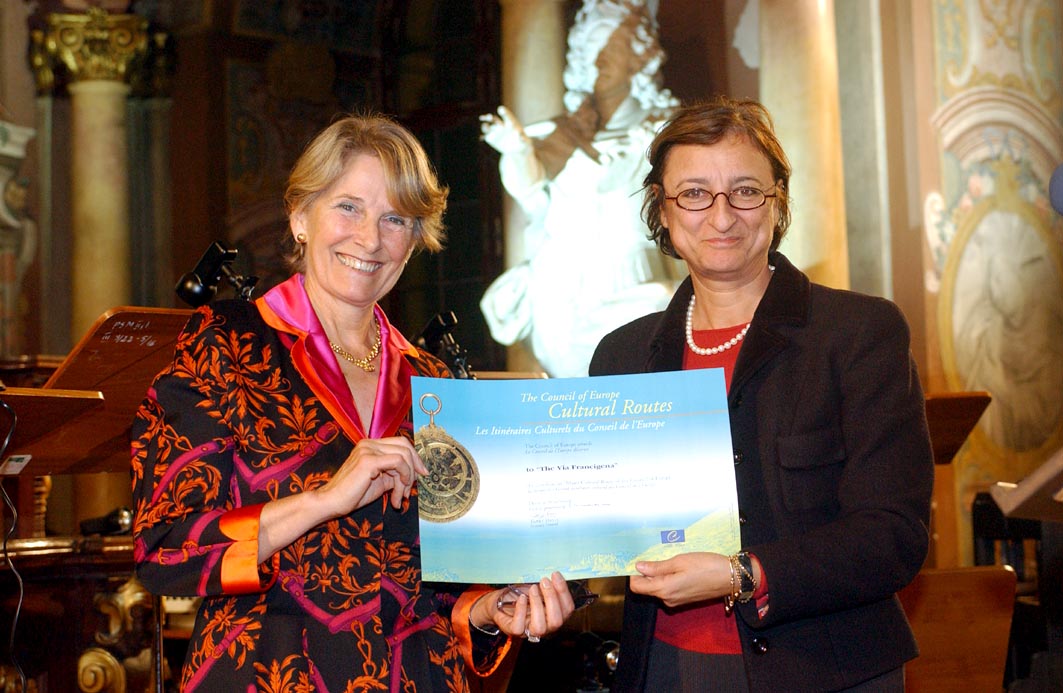
The Via Francigena has been designated as a Cultural Route by the Council of Europe in 1994 and in Dic. 2004 during the celebrations for the 50th anniversary of the European cultural convention in Poland has given the award
|
 |
to Mrs Adelaide Trezzini chairman AIVF by Mrs Gabriella Battaini-Dragoni General Director section IV of Council of Europe
Pontifical Council for Culture
On this website you can find information on the Via Francigena, and on what the association does to promote the route and support pilgrims. Click on the links above for further information.
The association forms a community of past, present and future pilgrims, and those who follow the Via or are interested in any aspect of the pilgrimage are invited to contribute to its work.
VF: Via Francigena
AIVF: Association internationale Via Francigena
IEIC: Institut européens des itinéraires culturels du Conseil de l'Europe/ European Institute for Cultural Routes
Contact us [email protected]
© All rights reserved Association internationale Via Francigena 2006